How Change Actually Takes Shape
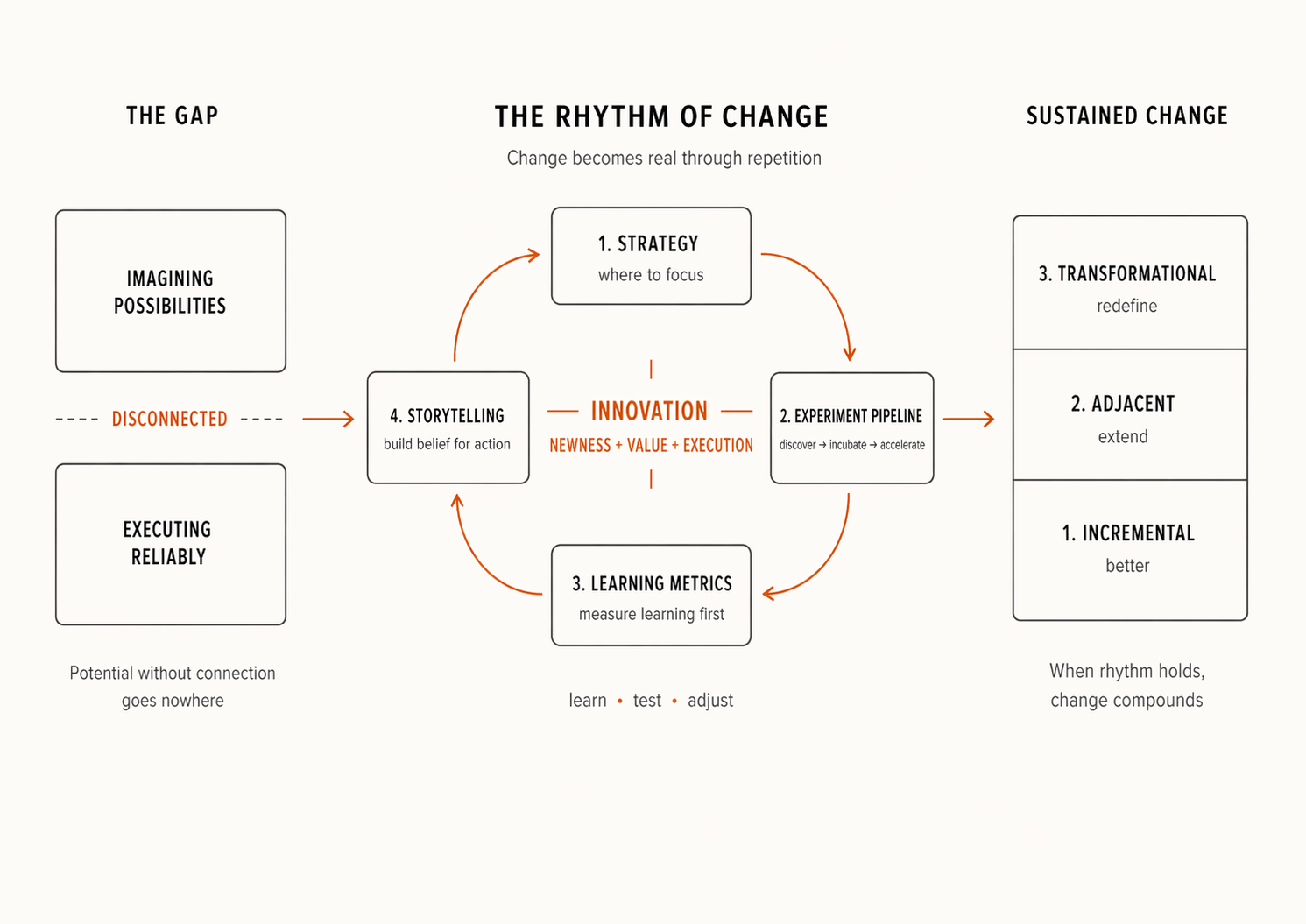
Change rarely comes from one breakthrough idea. It comes from a repeatable rhythm of learning, testing, adjusting, and building belief. Strategy gives innovation direction, experiments reduce uncertainty, the right metrics measure learning, and storytelling creates momentum. When these work together, innovation stops being an initiative and becomes a practice.
Most organisations I've worked with wanted innovation, but few had the structure to make it real.
The gap, almost every time, looked the same. The people who were strong at imagining possibilities often struggled to bring ideas to life. And the people who were good at execution hesitated when things got uncertain. So the two sides existed in the same organisation without really connecting, and most of that potential just went nowhere.
I used to think this was a talent problem. It wasn't.
It was a rhythm problem.
Real change rarely comes from a single breakthrough. It comes from repetition, the cycle of learning, testing, and adjusting that turns ideas into something that actually works. So the question isn't just what's new. It's what holds up over time.
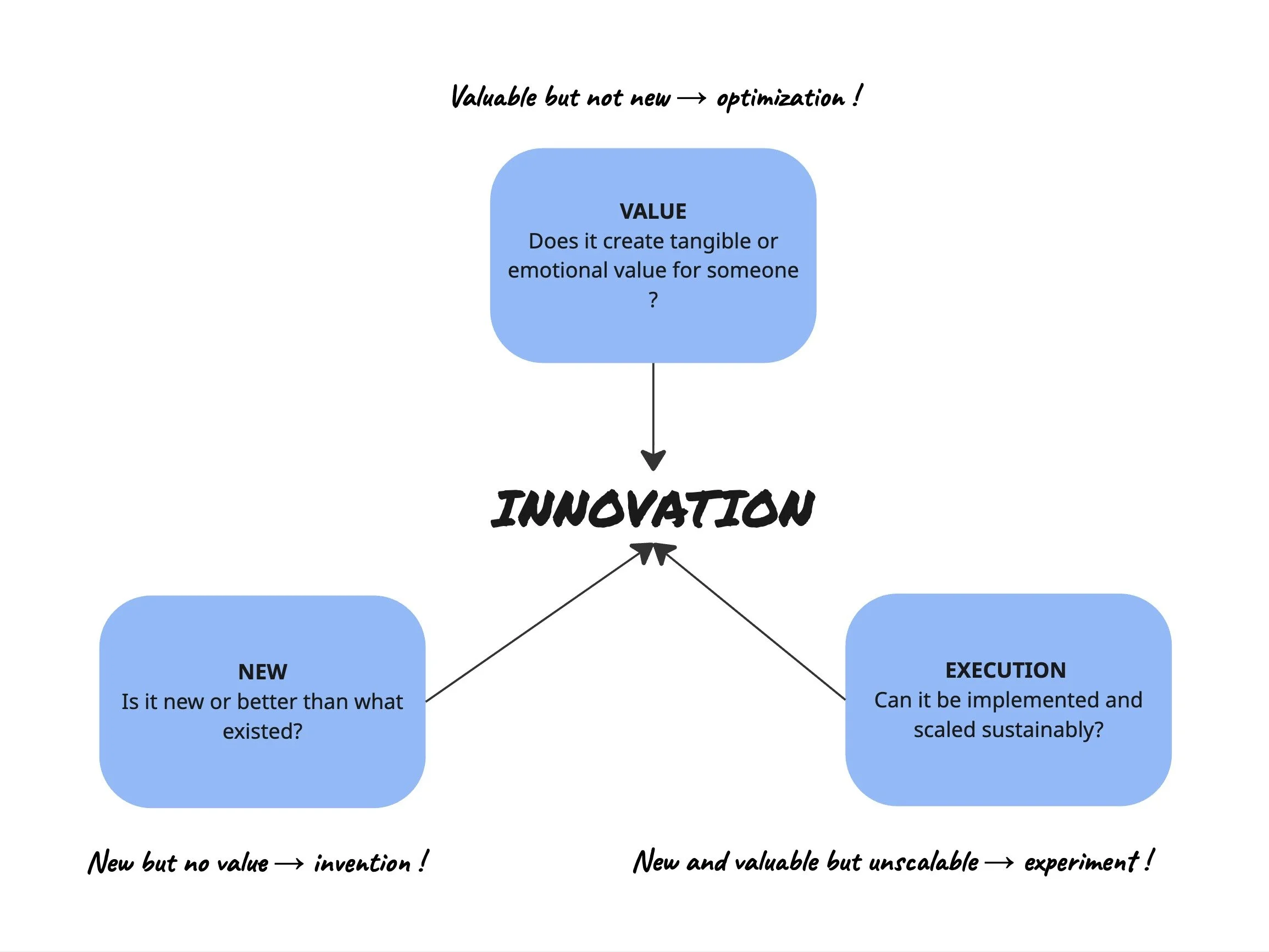
A useful lens: innovation sits at the intersection of three things: newness, value, and execution. You need all three. Something new without value is just an invention. Something valuable but not new is optimisation. And something new and valuable that you can't scale stays an experiment.
What makes this useful is that it stops you from calling something innovation just because it feels exciting, and asks you instead: Does it actually create value for someone? Is it genuinely new or better than what existed? And can it be built and scaled sustainably? Only when all three come together does something worth building actually emerge.
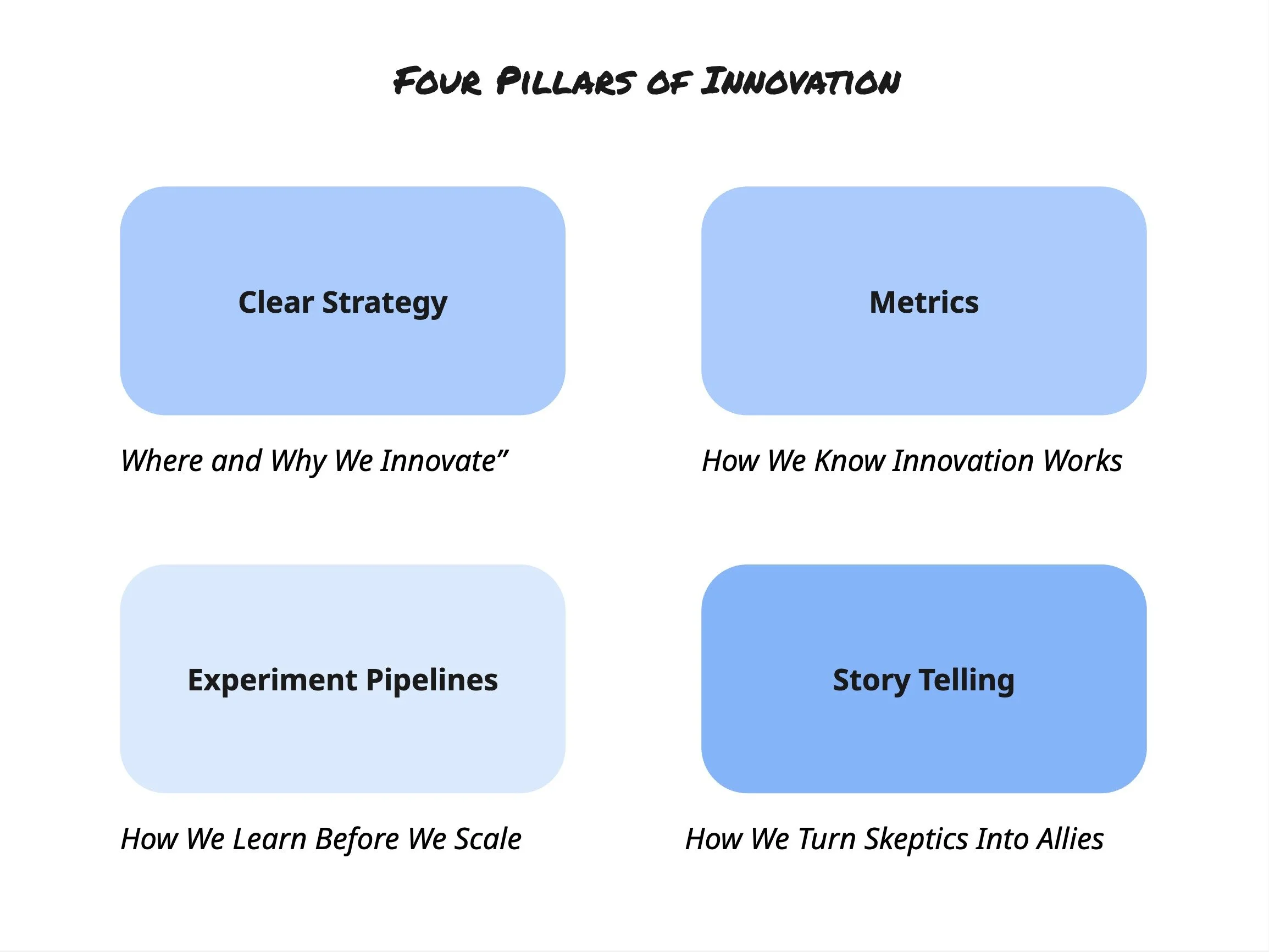
Behind sustained change, four things keep that rhythm going. And each one solves a different part of the problem.
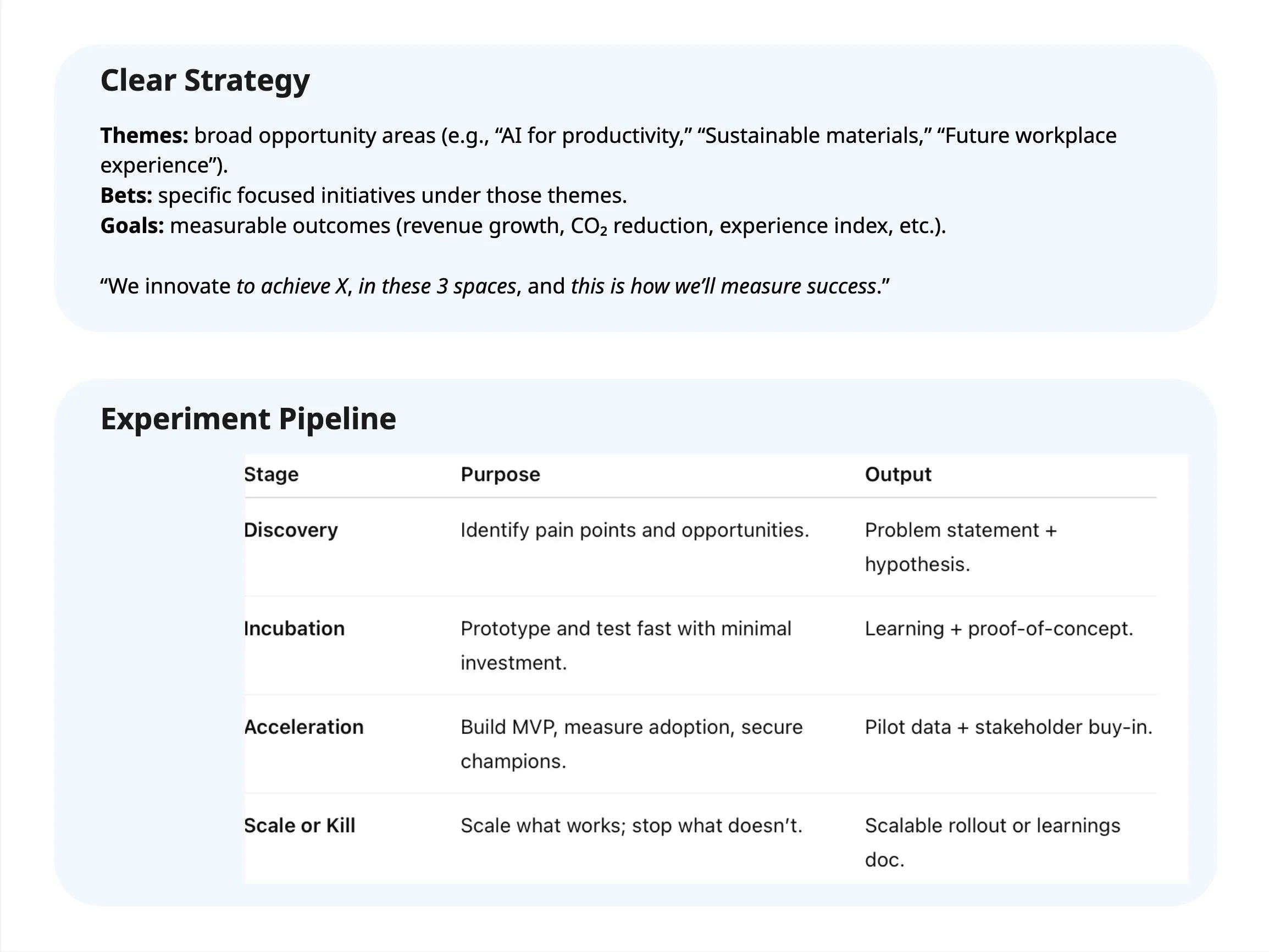
The first is a clear strategy, knowing where and why to innovate, and just as importantly, what's out of scope. Without this, every idea feels equally valid, and teams are spread thin across too many directions.
The second is an experiment pipeline, a way of moving ideas through stages rather than betting on them too early. Discovery, incubation, acceleration, and then a decision: scale or stop. The point isn't to protect ideas. It's to learn quickly before committing fully.
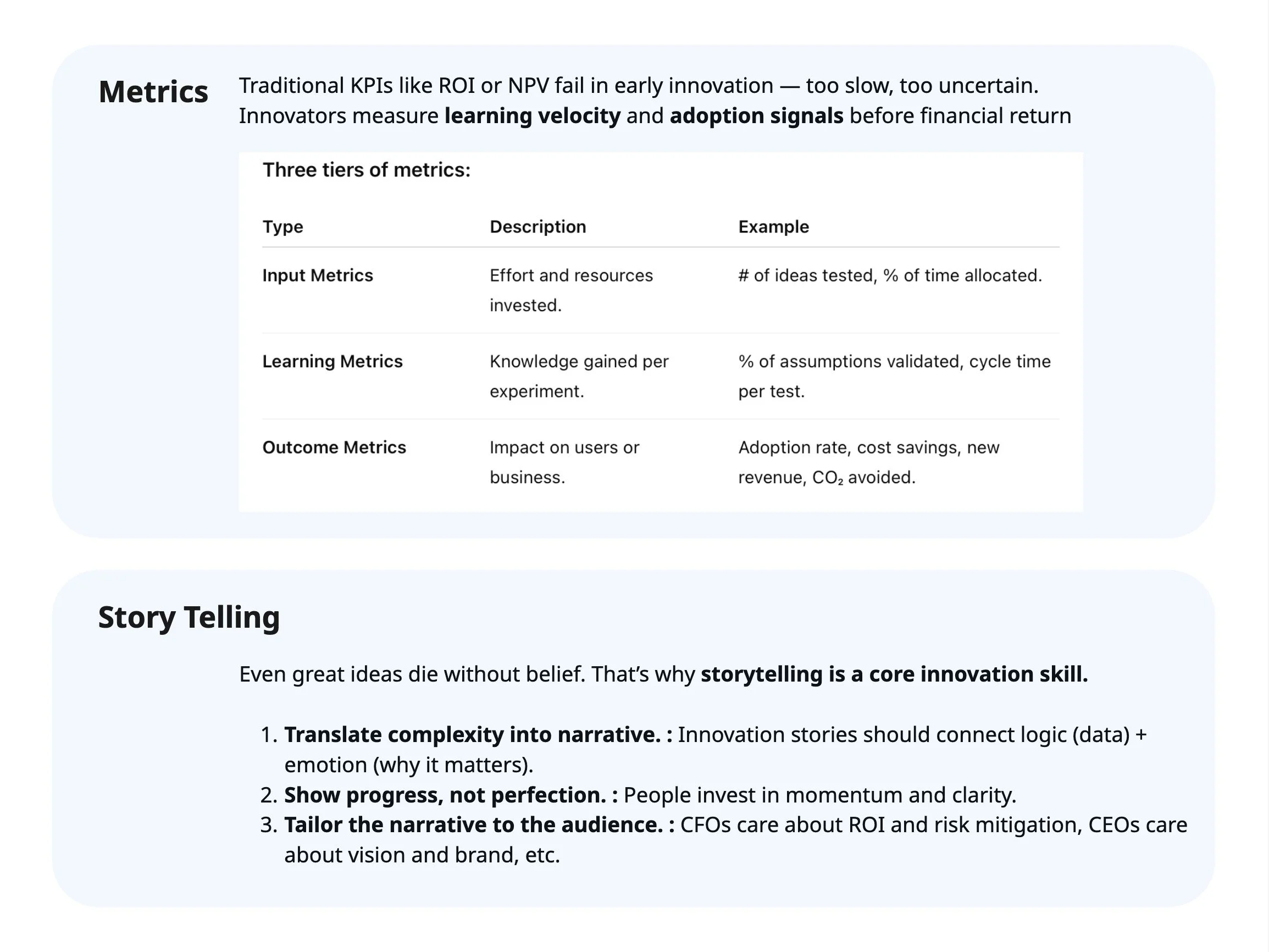
The third is the right metrics. This is where most organisations get it wrong. They try to measure innovation the way they measure the rest of the business, with ROI, NPV, and financial returns. But those metrics are too slow and too certain for early-stage work. What you actually want to measure first is learning velocity: how fast are you validating or disproving your assumptions? The financial return comes later, once you know something actually works.
The fourth is storytelling, and this one tends to get underestimated. Even great ideas die without belief. Numbers show that something works, but stories are what move people to act. The job of storytelling isn't to simplify the work. It's to connect the logic of what you're building with why it matters to the person you're talking to. A CFO needs to hear risk and return. A CEO needs to hear vision and direction. The story is the same; the emphasis shifts.
When these four work together, innovation stops being a conversation and becomes a practice.
Mature teams approach this less like a creative burst and more like a learning process. They design experiments to test assumptions, not confirm them. And they optimise for understanding rather than certainty, because progress comes not from being right early, but from learning faster than things change around you.
Not all change happens at the same depth, either.
Think of it as three layers sitting inside each other. At the core is incremental change. This is about making what already exists faster, cheaper, or better. A good example would be standardising a design process to cut delivery time.
The next layer out is adjacent change, which means taking something you already do well and extending it into new territory. Turning an internal analytics capability into a product you offer to other companies, for example.
And at the outermost layer is transformational change, where the system itself gets redefined. Reimagining the office not as a fixed location but as a network of on-demand creative spaces powered by AI would sit here.
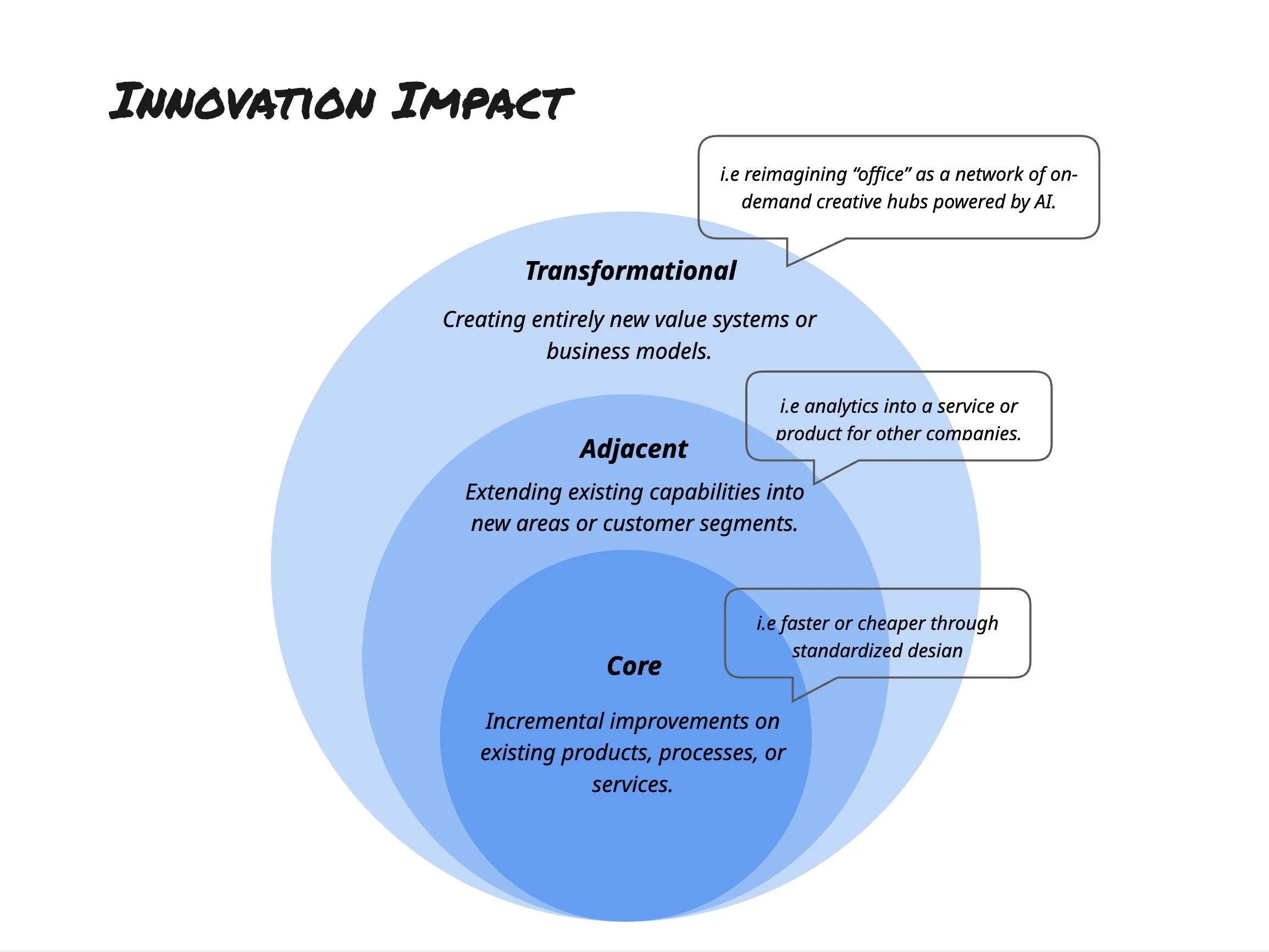
The temptation is to focus on one of these layers. But they're not a sequence. They're meant to move together. Organisations that treat them as phases usually get stuck optimising the core, while transformation never really starts.
Change doesn't fail because ideas are weak. It fails when the rhythm breaks: when learning stalls, stories get lost, or execution disconnects from what was intended.
When the rhythm is there, change stops feeling forced. It starts to compound.