Clarity Before Certainty
Difficult decisions often don’t suffer from a lack of data. They suffer from people answering different questions. Before comparing options, teams need to agree on what they are actually optimising for. Better framing makes the real trade-offs visible, and often creates more progress than another round of analysis.
A common assumption in business is that better decisions come from better data.
If a decision felt difficult, the answer seemed obvious: gather more information. Build another model. Run another workshop. Ask another expert. Given enough time and effort, the uncertainty would eventually shrink until the right answer revealed itself.
Sometimes that works.
But some of the most difficult decisions I've worked on were never really about missing information. There was often plenty of it. The spreadsheets were complete. The analysis was thorough. The expert had spent months examining the problem from every angle. And yet the decision stayed stuck.
The problem usually isn't that people disagree on the answer. It's that they're answering different questions.
A few years ago, I was involved in a major long-term investment decision. The numbers were significant, the consequences would last for years, and multiple teams had a stake in the outcome.
From the outside, it looked like a discussion about selecting the best option.
Inside the room, something else was happening.
Finance was evaluating capital exposure and long-term cost. Operations was focused on execution risk. Leadership was thinking about future growth. Legal was concerned with flexibility and reversibility.
Everyone was discussing the same proposal. Everyone was looking at the same data. Everyone was acting rationally. Yet the conversation kept circling.
The meetings felt productive. There were presentations, workshops, spreadsheets, recommendations, and healthy debate. New insights emerged every week. More information was gathered. More analysis was produced. Yet somehow, progress stayed slow.
Looking back, I don't think the organisation lacked expertise. It had plenty. What it lacked was agreement about the decision itself.
People assumed they were discussing the same problem because they were discussing the same proposal. In reality, each group was trying to optimise for something different.
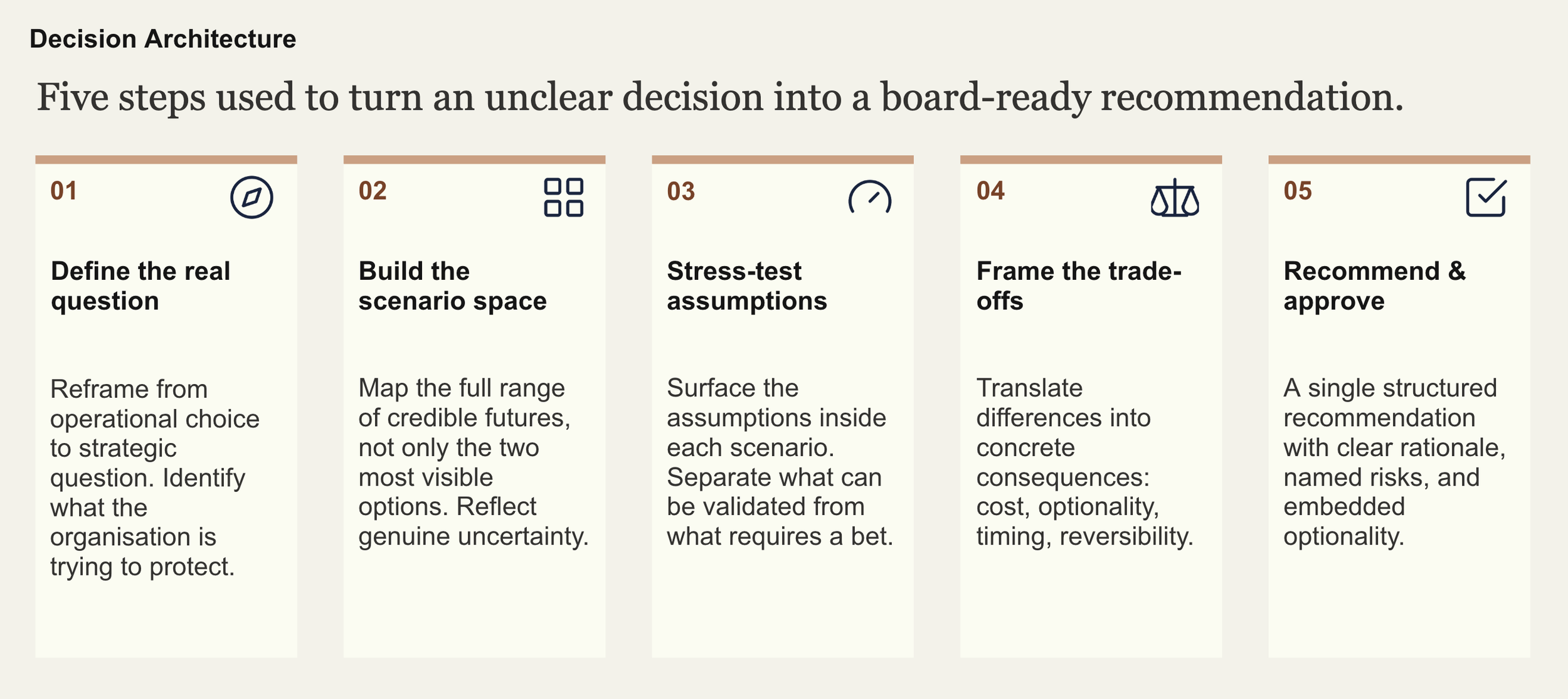
The breakthrough didn't come from another model or another workshop. By that stage, there was very little left to analyse. It came from a deceptively simple question: what are we actually trying to optimise for?
Until that moment, the discussion had revolved around options. Which scenario carried the lowest risk? Which path was the most cost-effective? Which solution offered the greatest benefit?
But those questions were sitting on top of a more fundamental one.
What outcome matters most? Growth? Flexibility? Speed? Risk reduction? Future optionality?
The moment that question became clear, the conversation changed. We hadn't changed the data. We hadn't changed the options. We hadn't changed the assumptions.
We had changed the frame.
And once the frame was clear, we could finally see the trade-offs.
This is something I now notice everywhere.
Teams debate platforms before agreeing on what problem the technology is supposed to solve. Leaders discuss new structures before agreeing on what behaviour they actually want to encourage. People line up initiatives before agreeing on the outcome they're trying to create.
People often ask: "Which option should I choose?"
A more useful question is: "What am I optimising for?"
The same opportunity can look brilliant or terrible depending on the question sitting underneath it. What looks like a decision about options is often a decision about priorities.
Over the years, I've started to suspect that a lot of strategic decisions are really trade-off decisions wearing a different costume.
On the surface, organisations talk about finding the best option. Underneath, they're deciding which uncertainty they're most willing to live with. Every meaningful decision closes certain doors while it opens others. More speed often means less certainty. More flexibility usually comes at the cost of efficiency. More commitment reduces optionality. Holding onto optionality often slows momentum down.
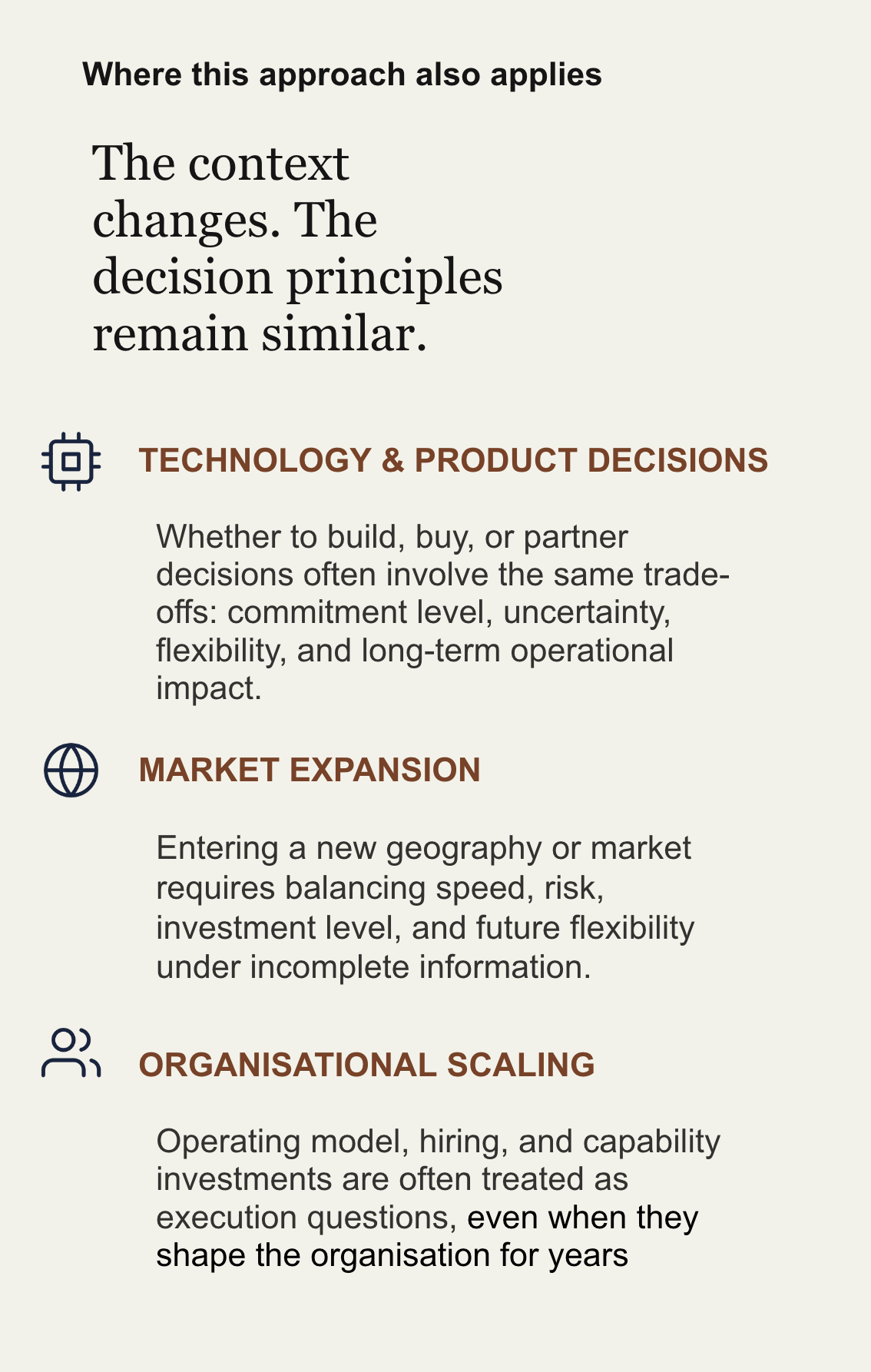
Seen through that lens, getting honest about the trade-off you can live with matters more than finding a perfect answer.
That is why framing matters so much. A well-framed question exposes the real trade-offs. A poorly framed one hides them.
The people I've learned the most from in moments like this weren't necessarily the ones with the strongest opinions or the deepest expertise. They were the ones who could step back from the noise and get curious about the question itself, before rushing toward a solution. While everyone else debated answers, they were quietly defining the decision.
At the time, it felt slower. Looking back, it was usually faster. A few hours spent clarifying the question saved months spent debating the wrong answers.
Maybe that's one of the quieter parts of leading, helping people get clear enough on the question to move forward together, even without certainty or all the answers.
It's also a question that matters more as decisions start getting handed to algorithms and AI agents. A system can optimise for almost anything, but someone still has to decide what "good" looks like before it can. Automation doesn't remove the framing question. If anything, it makes it harder to skip.
Complexity has a strange effect. Under pressure, people start reaching for certainty when what they actually need is clarity.
And some of the most expensive mistakes happen when people answer the wrong question with total confidence.
