Designing an Operating System for Better Decisions
The exhausting part of job searching wasn’t applying. It was making the same decisions over and over. I built a system to filter noise, prioritise what matters, and learn from my own judgement over time. The goal isn’t automation or productivity. It’s calibration: the system remembers the rules and patterns, while the final decision stays human.
There is a difference between having an idea for a system and actually running one every day.
Over the past few months, I wrote several times about building a decision system for my job search. At first, the writing focused on the philosophy: protecting attention, reducing noise, avoiding reactive decisions.
But a question kept appearing in the replies. How does it actually work?
So this article is less about the theory and more about the operating system itself. The screens, the logic, the rules, and what changed once I started using it consistently.
The interesting part was not building another tracker. It was realizing how much mental load came from constantly reopening the same decisions.
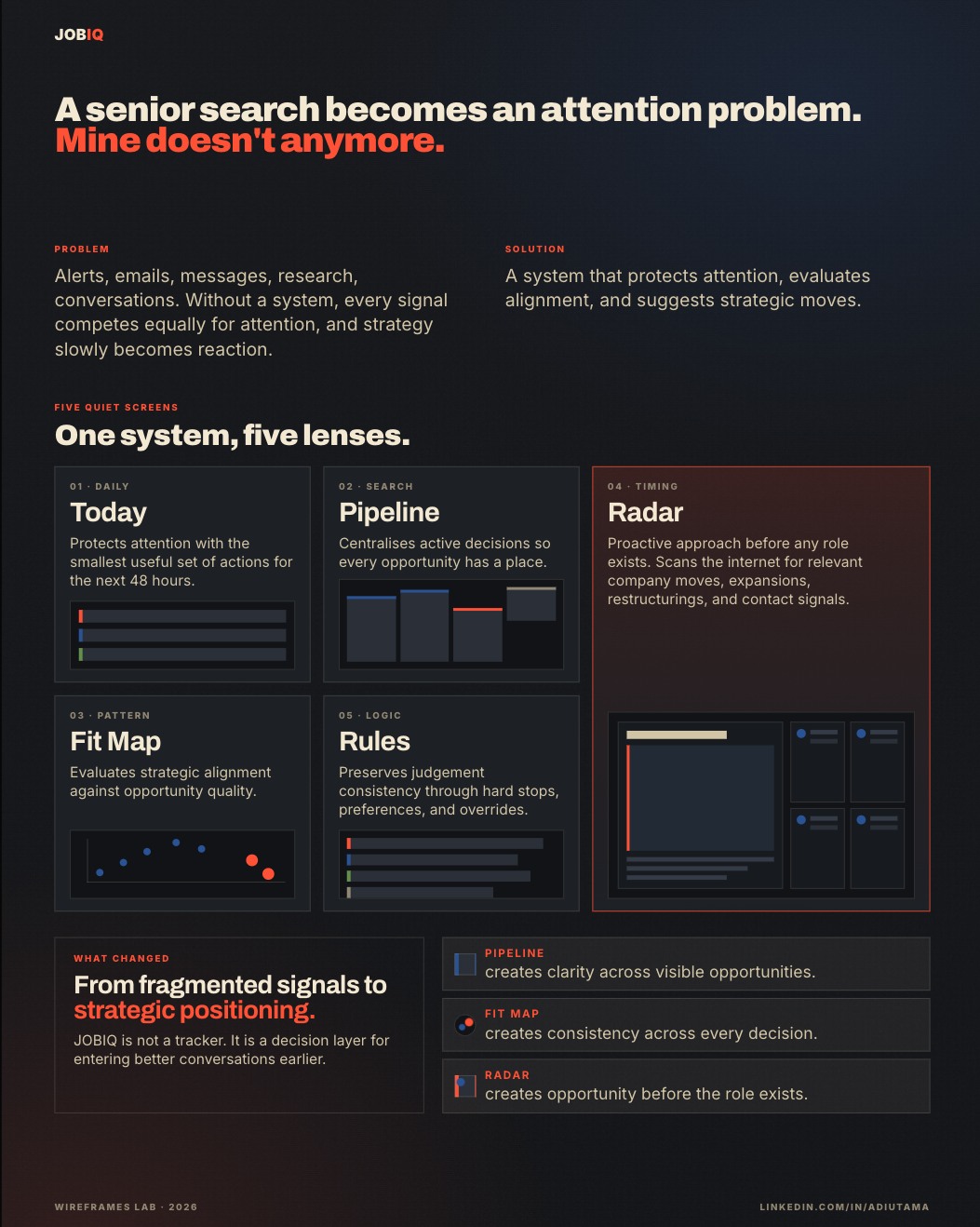
The system has five views: Today, Pipeline, Fit Map, Radar, and Rules. Each exists to solve a different behavioral problem. The goal is judgment, not productivity.
TODAY
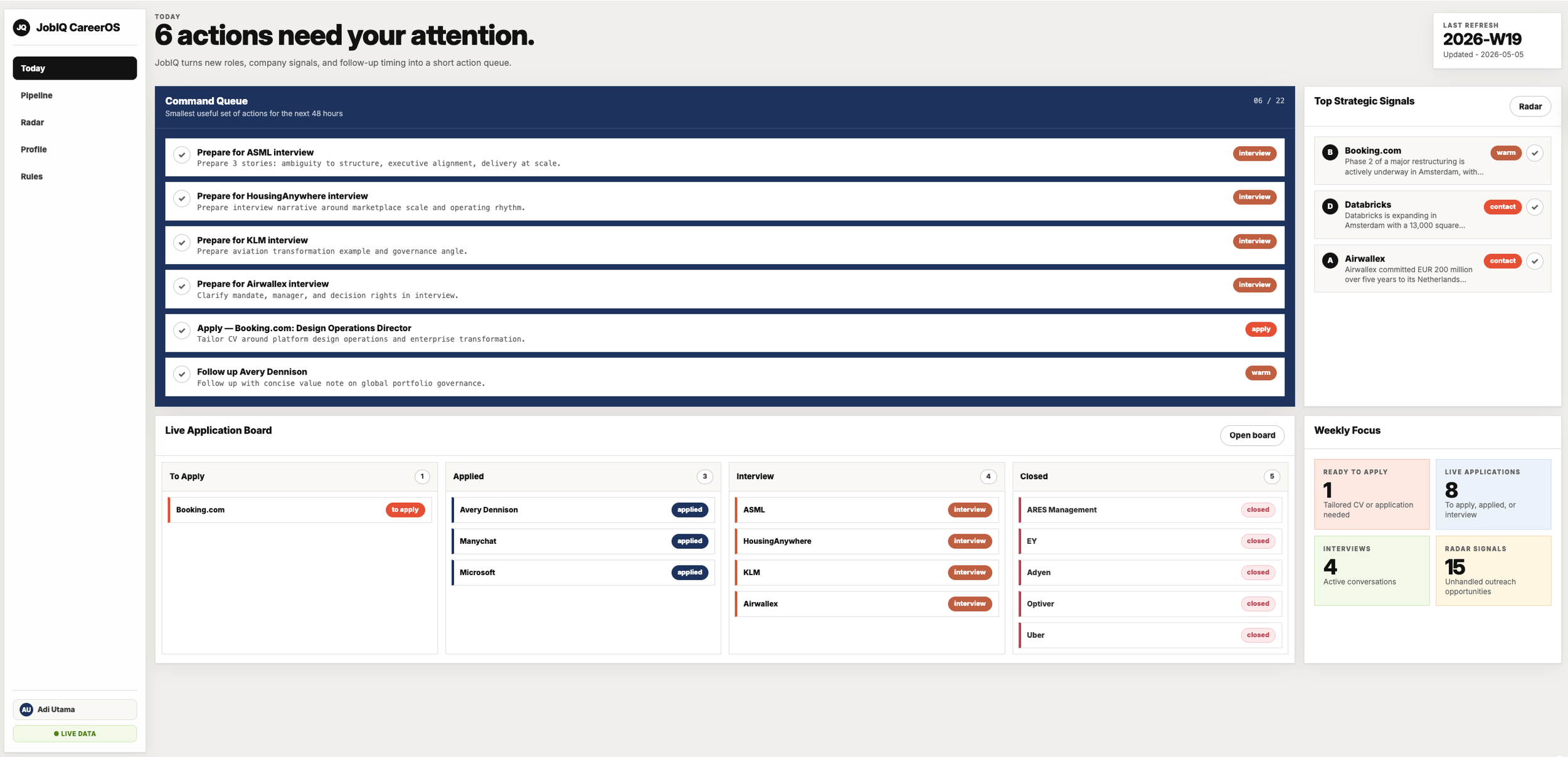
The first screen is the most important dashboard.
When I open the system in the morning, I do not see every application, every possibility, or every outstanding task. I see the smallest useful set of actions for the next 48 hours.
This week the queue showed six things: interview preparation, one application to finalise, and a follow-up that had been sitting untouched for fourteen days.
That is it. Nothing else.
No giant dashboard asking for interpretation. No overwhelming backlog. No 40 open loops competing for attention.
Most systems fail because they confuse visibility with clarity. Showing everything at once does not reduce stress, it transfers the burden of prioritization back onto you. The Today screen makes one decision before I even start: this is what matters right now. Everything else can wait.
PIPELINE
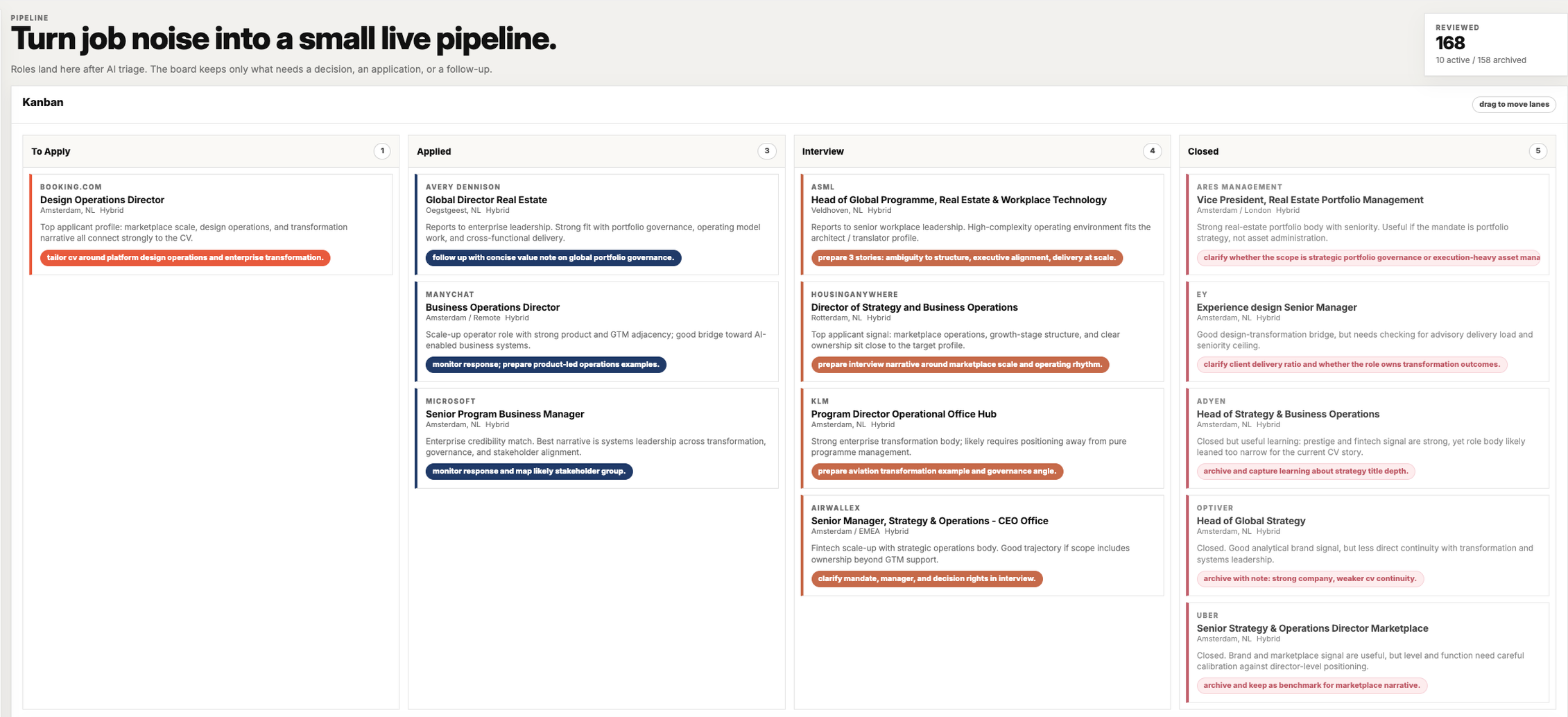
The Pipeline holds the entire search.
168 roles have been reviewed since March. 13 are in the active pipeline: one ready to apply, three in progress, four in interview, and five that closed before they converted. The rest are archived.
When I tell people those numbers, 168 reviewed, 13 remaining, the reaction is usually surprise. That seems like a lot of filtering. But the filtering is the point. The volume of inbound in a senior job search is genuinely high: LinkedIn alerts, recruiter outreach, referrals, conversations, roles that look attractive on a Tuesday and questionable by Thursday.
Without structure, everything lands in the same mental pile. The real exhaustion comes not from applying but from repeatedly reopening unresolved decisions.
The pipeline solved that by separating active decisions from archived ones. Roles that fail the filter are archived, not deleted. That distinction matters psychologically. Deletion creates doubt, what if I dismissed something good too quickly? Archiving removes a role from active attention without removing the learning. The system remembers. I no longer have to.
FIT MAP
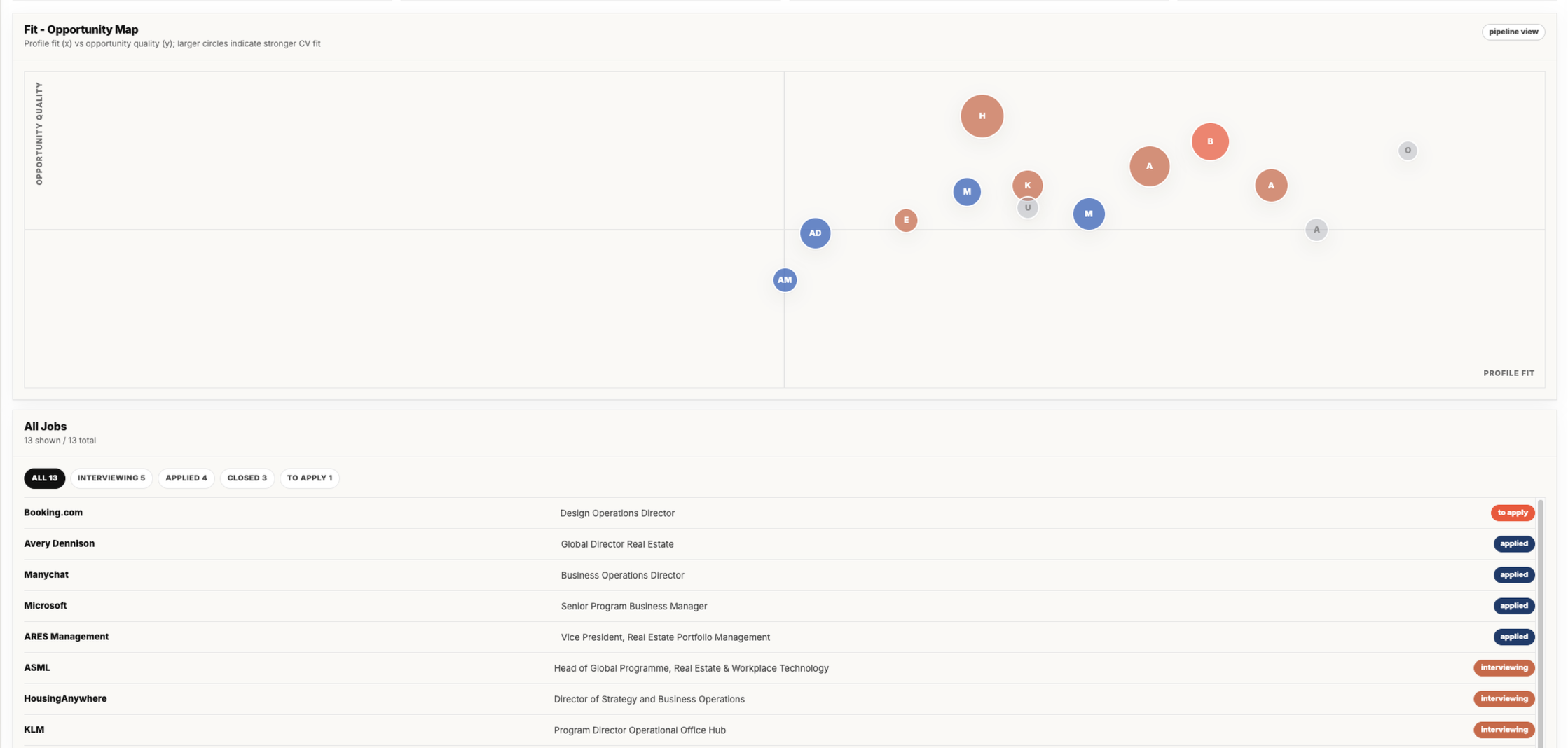
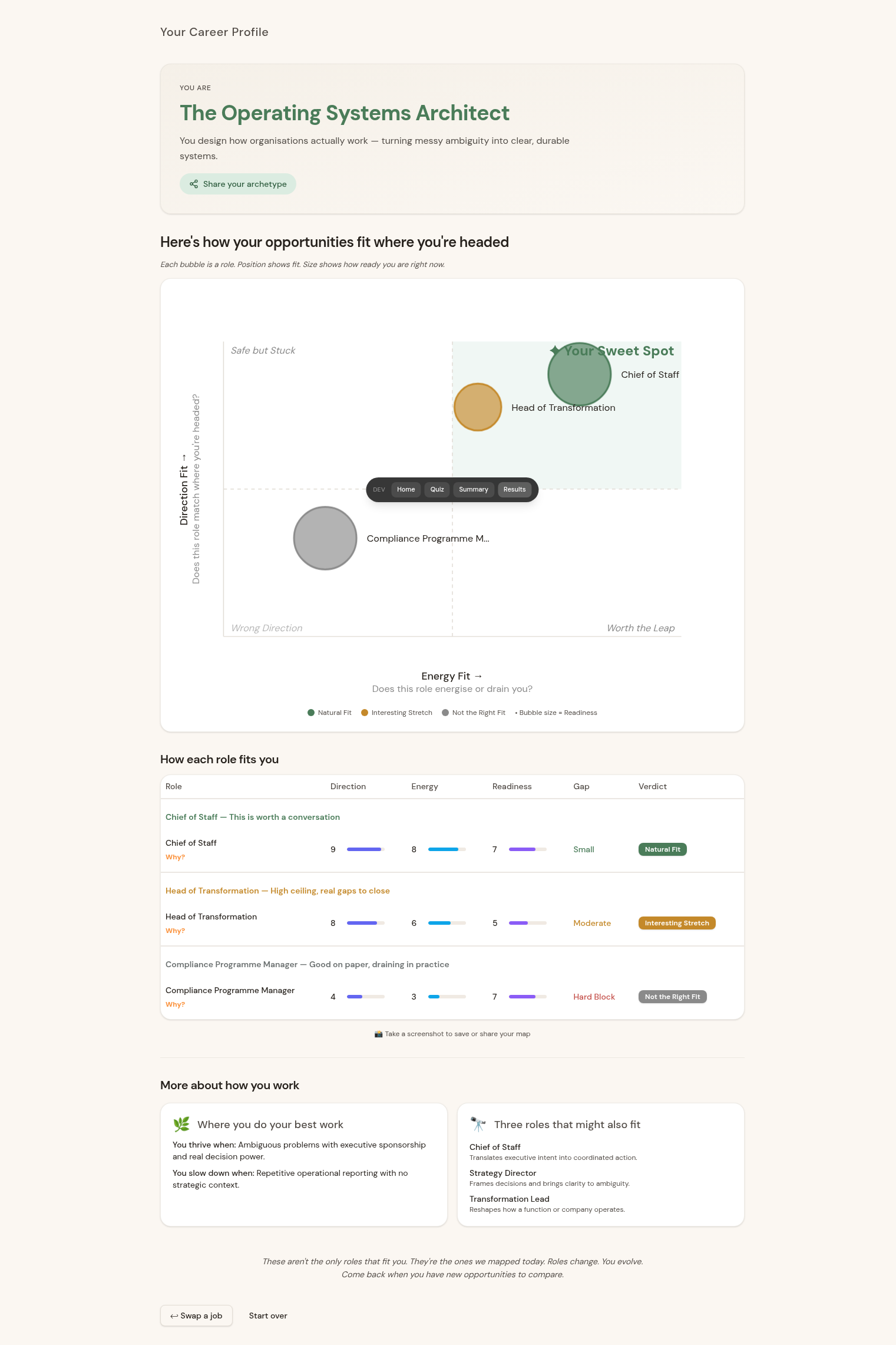
Every active role gets plotted on two axes: profile fit on one side, opportunity quality on the other. The size of each dot reflects how well the CV actually matches. The result is a single view of the entire search.
The map does not decide for me. It exposes patterns.
That sounds subtle, but it changed how I evaluate opportunities entirely. When reviewing roles individually it is easy to rationalize. Prestigious brand, strong compensation, an exciting title. But when every role appears on a single map at the same time, inconsistencies become visible immediately. Some opportunities kept drifting lower on profile fit despite looking strong on paper. Others sat consistently in the upper-right corner without much fanfare.
The map reduced self-rationalisation. The question stopped being "does this role sound good?" and started being "why does this role keep landing here?" That is a more useful question.
RADAR
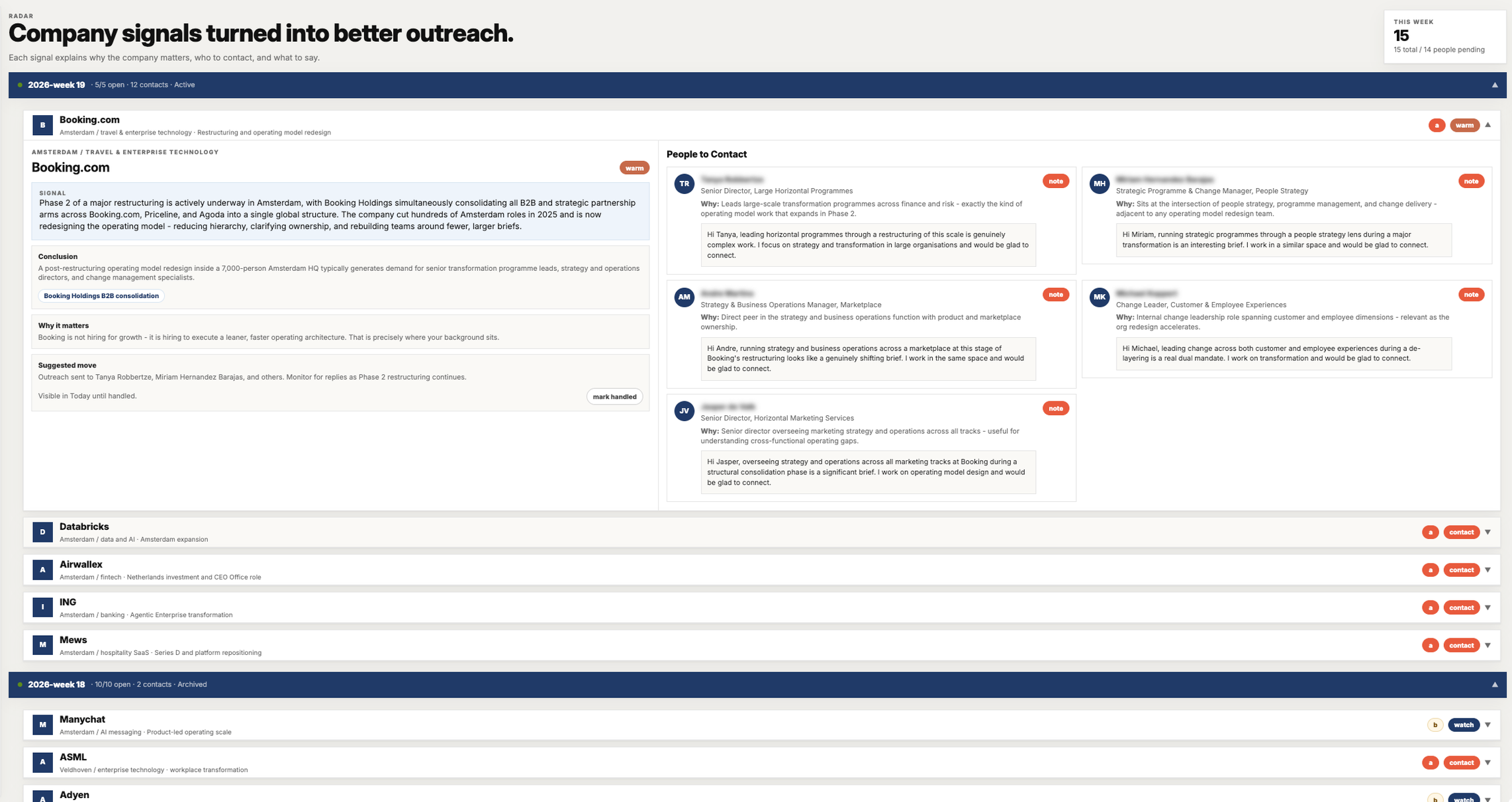
Radar was not part of the original design. It emerged after I realised that filtering passively was only half the problem. The other half was timing.
Each week Radar scans the news for company signals : restructurings, funding rounds, leadership changes, expansion plans, operating model shifts. It translates each one into contextual outreach. Not generic networking, but a specific reason to reach out at a specific moment.
This week it surfaced fifteen signals.
The strongest was Booking.com. A major restructuring is underway, consolidating multiple strategic partnership and B2B functions into a single global structure. Hundreds of Amsterdam roles were already cut in 2025. Now the operating model itself is being redesigned.
Other signals this week included Databricks expanding into Amsterdam, Airwallex investing heavily into its Netherlands operations, and ING restructuring around agentic AI initiatives.
Companies reveal what they need long before roles appear publicly. Radar makes those signals easier to notice.
PROFILE
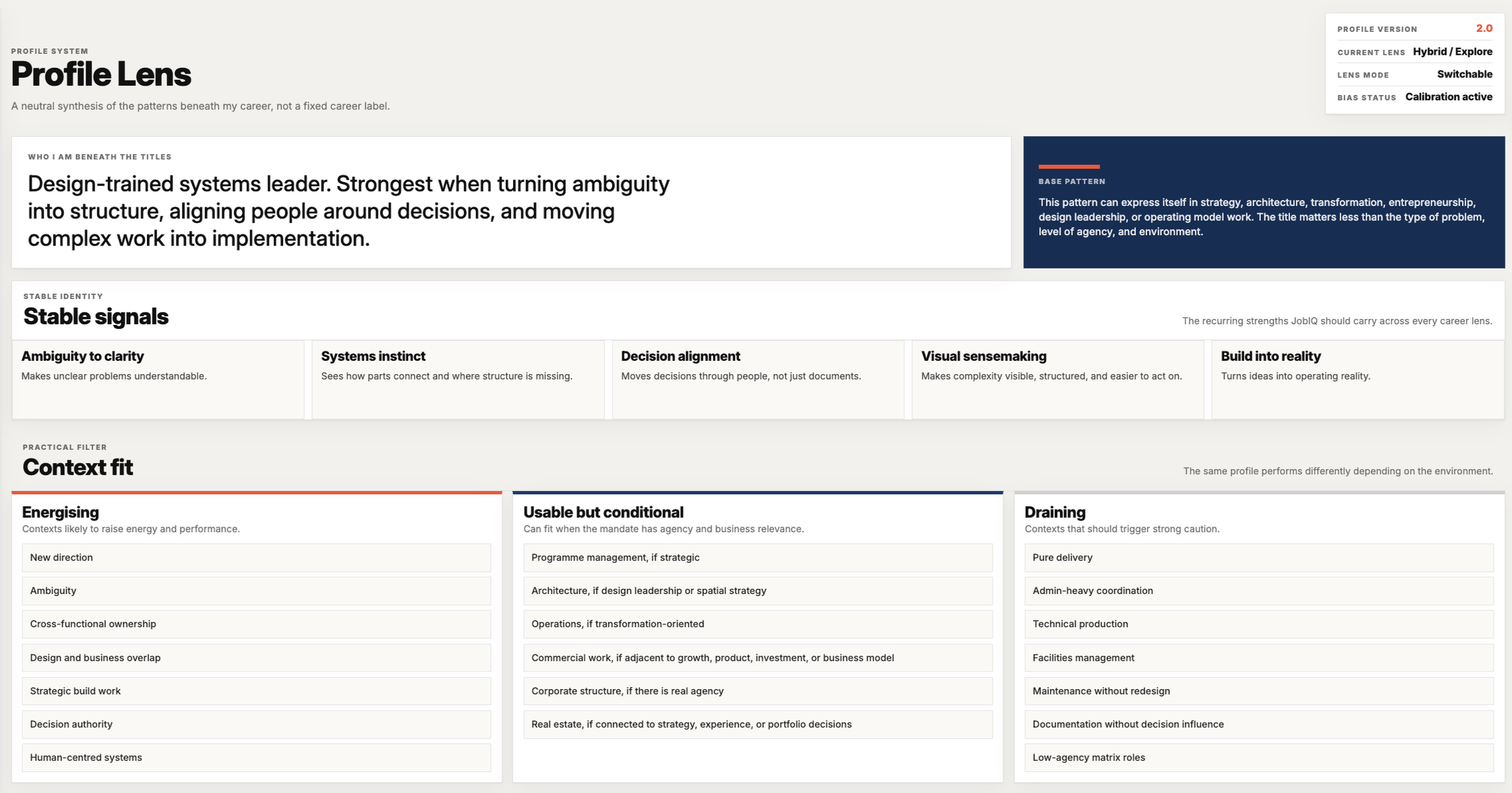
Profile is not a CV summary. It is the lens the system evaluates against.
It was generated from inputs accumulated over several years: a few versions of my CV, colleague feedback, 360 reviews, and several personality and strengths assessments, including HBDI, Big Five, CliftonStrengths, and 16Personalities.
The system read across all of it, identified recurring patterns, and produced a single integrated view of how I tend to work best.
What surprised me was the recognition.
I have read enough assessment reports to become somewhat immune to them. But seeing patterns named with precision across sources collected independently, at different points in my career, produced a different kind of clarity.
What the profile produced was not a picture of who I think I am.
It was a working hypothesis about the environments where I perform well and the ones where I quietly deteriorate.
That distinction became the logic behind the Context Fit map.
Three columns:
Energising contexts, where the profile predicts a genuine performance lift
Conditional contexts, where fit depends on how the mandate is structured
Draining contexts, flagged as risks regardless of how attractive the role looks on paper
The map feeds directly into the filter.
When a role arrives, it is evaluated against this profile. Not just stated preferences, but patterns grounded in everything that came before the search.
Before the system could assess opportunities consistently, it needed a reliable answer to a question most career advice never asks: Not only what do I want, but what kind of environment brings out the right version of me?
RULES
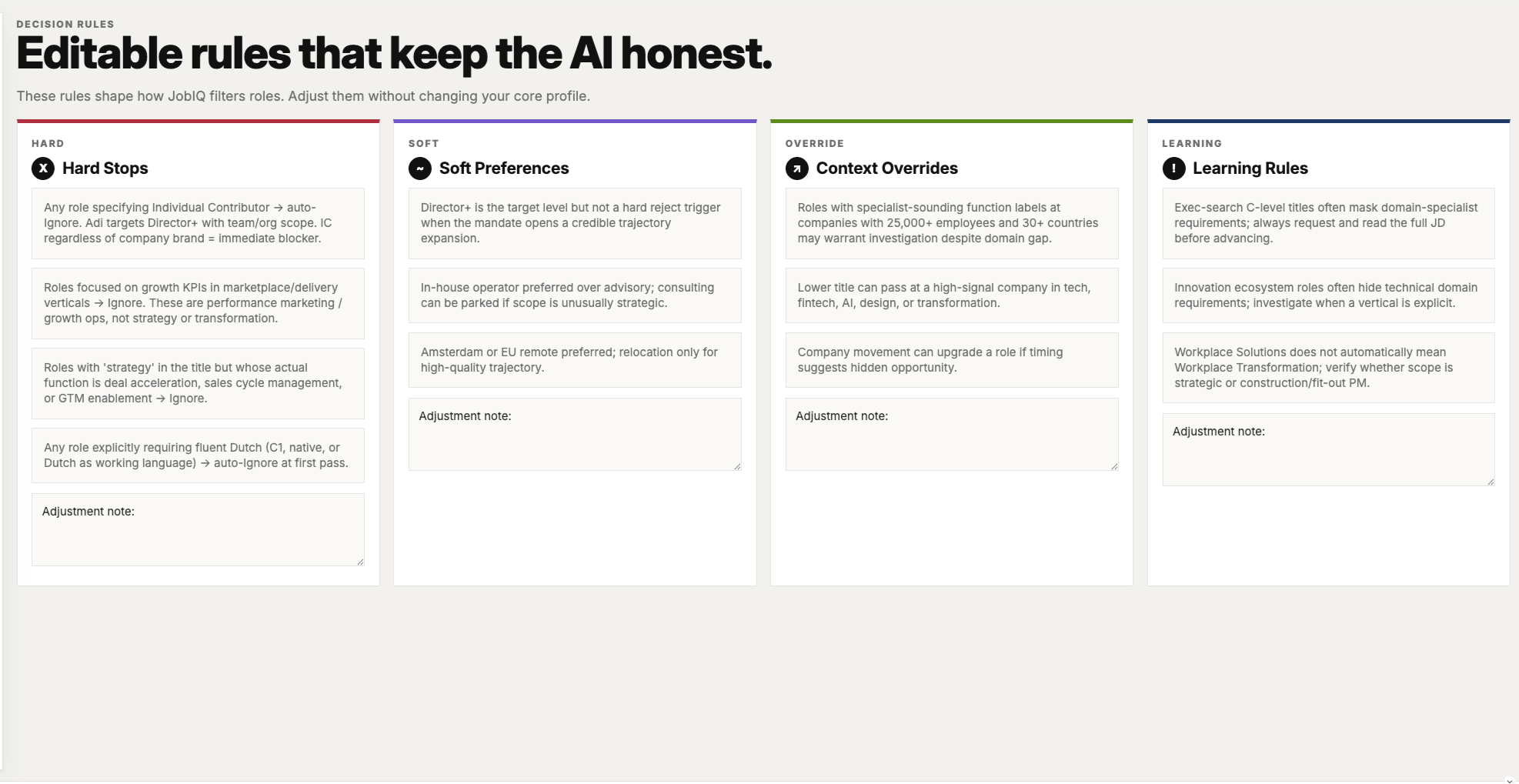
Rules are where the system stops being a dashboard and becomes an operating model.
They are organised into four types, each doing a different kind of work.
Hard Stops are binary. If a condition is met, the role is removed before I read further. One example: any role explicitly requiring fluent Dutch is auto-ignored at first pass, regardless of everything else.
Soft Preferences are filters that can bend when the context is strong enough. The default is in-house over advisory, but that preference can be overridden if the mandate is genuinely strategic and the scope is right.
Context Overrides exist for moments when a signal is strong enough to warrant looking past the normal filter. A lower title at a high-signal company in AI, fintech, or transformation can still pass. The company trajectory matters as much as the role description.
Learning Rules capture what the system picks up from disagreements. If I override an AI recommendation, the override gets stored, not as an error, but as a data point.
One example the system has learned: Workplace Solutions is not the same as Workplace Transformation, and the distinction is rarely visible in the title.
The purpose of the system is not automation.
It is calibration.
The judgement still belongs to the human. The system simply runs the criteria consistently and makes patterns visible across a volume of information that is difficult to track manually.
What I Didn't Expect
A few weeks after publishing the first version of this framework, I became curious whether the logic could survive outside my own notes. So I rebuilt parts of it as a small experiment using Lovable and Claude. https://opportunity-fit.lovable.app/
The goal was not to create another job-search tool. There are already plenty of those. I wanted to test a simpler question.
Could a system help people make their reasoning more visible?
Thirty-six people tried it during the first few weeks. Most arrived through LinkedIn. The average session lasted more than six minutes, which surprised me. What surprised me even more was where people spent their attention.
I assumed the opportunity map would be the main attraction.
Instead, many people spent longer reading the profile itself.
The part describing how they work. The environments that energise them. The situations that quietly drain them.
The exercise reinforced something I had started noticing while building the system.
People are often less uncertain about their options than they are about themselves. The most useful part was not the recommendation. It was recognition.
The opportunity map simply made that recognition visible.
Which leads to a question I did not expect this project to raise.
How many important decisions rely on intuition that we have never taken the time to examine?