
The Right Job. Not Just a Good One

Most people search for a good job. But good and right are two different things. This piece introduces a four-dimensional map, adapted from Ikigai, that helps you see where a role actually sits, and why most opportunities only land in one or two intersections, not the centre.
How do you find the right role, and not just the good one? The one that brings you closer to your best potential and, dare I say, to a more fulfilled version of yourself?
I've been sitting with that question for a while now.
I've found many roles that look good: nice titles, solid companies, good salaries. And yet, something doesn't click. Eventually, I realised I had been asking the wrong questions entirely.
Most people approach a job search with a few surface questions: Can I do it? Will it look right on my CV? Does it pay? Of course, all of those are valid. They're just incomplete. Because a job can be good, and still not be the right one.
I think most people have felt this at some point. You've spent almost two decades working. Things are going well. You're delivering. People trust you. And still you question it. It doesn't always come from unhappiness. Sometimes it comes from honesty, curiosity, or that slowly louder inner voice. Is this it? What's next? What else could I do really well? What does the next era of me actually look like?
That voice is not a problem to fix. It's information.
I've been thinking a lot about Ikigai during this period. Most people know it as a Japanese concept about purpose, built around four questions: What are you good at? What do you love? What does the world need? What can you be paid for? Useful, but not designed for a live job search. Too philosophical, too slow, and the dimensions don't map cleanly onto what you're actually deciding when a real opportunity is in front of you.
So I treated this as a system design problem. I adapted the Ikigai framework into four dimensions:
What you've actually proven (not what you're capable of in theory, but what you've delivered, with real outcomes)
What genuinely drives your energy (the specific conditions where you do your best work, not abstract "passion")
What the market values right now (not two years ago, not trends, what is actually moving at your level today)
What you can sustain over time (lifestyle fit, energy, whether this role still makes sense in three years)
The intersection of those four is the right role.
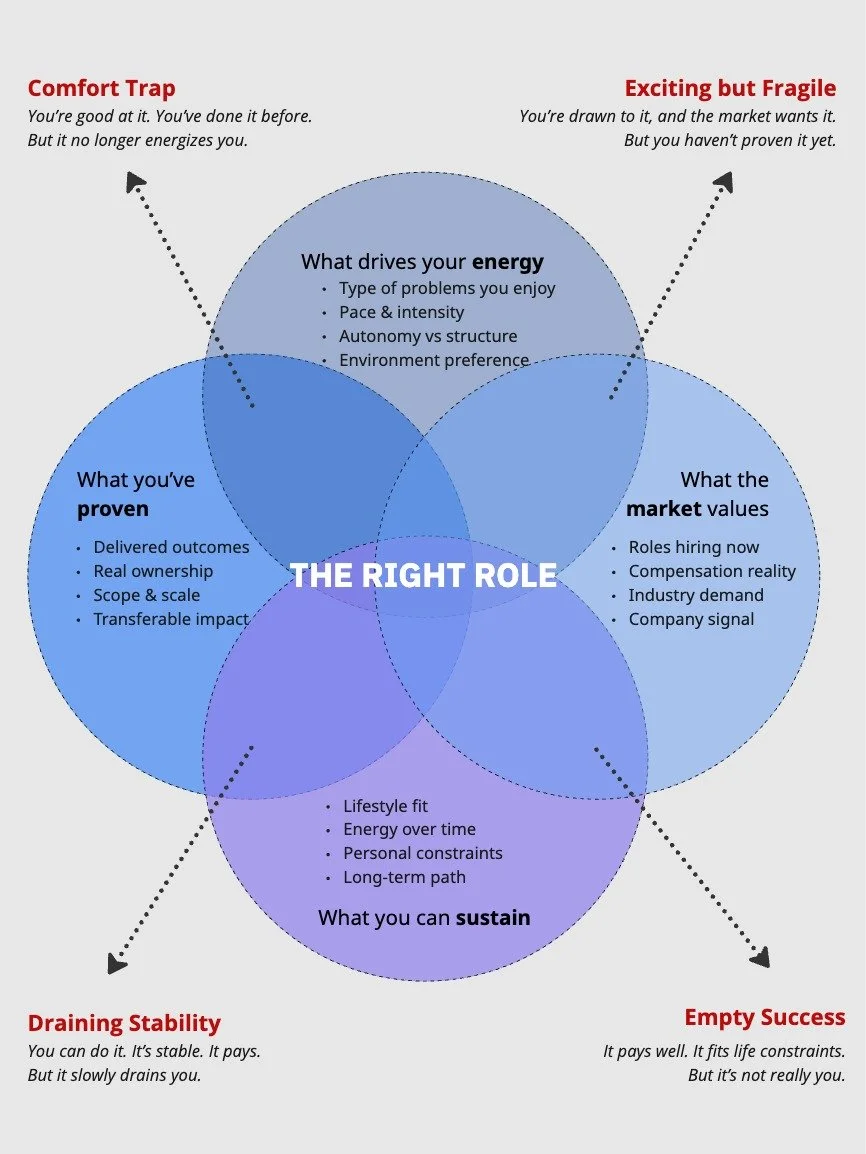
Here is what makes the map useful. A role can look good enough on its own. It ticks boxes. It makes sense on paper. But when you zoom out and place it on the map, you start to see where it really sits. Most of the time, it only lands in one zone, or maybe two intersections. Rarely all four.
That's when the hidden costs become visible.
A Comfort Trap fits what you've proven and what the market values, but sits outside your energy and sustainability. You're good at it, you've done it before. But it no longer feeds you, and the slow disengagement usually arrives around eighteen months in.
Exciting but Fragile sits at the energy intersection but without the proof. The market wants it, you're drawn to it, but you haven't yet built the track record at that level. It's not a trap, but it requires honest self-assessment.
Draining Stability aligns with what you've built and fits your life, but doesn't energise you. Safe, fine, it works. The cost only becomes clear in retrospect, usually when you're already tired.
Empty Success feels right from the inside. It energises you, it fits your life, you believe in it. But the market isn't really there for it at your level. There's a ceiling, and the gap between the feeling of the work and its actual trajectory creates its own kind of frustration.
Most of what I was reviewing was landing in one of those four zones. Not in the intersection.
That's when the question changed. Not: is this a good role? But: where does it actually sit on the map?
It sounds like a small shift. But it completely changed how I read opportunities. I stopped getting pulled in by company names and titles. I started getting curious about fit. A role at a well-known organisation can still be a Comfort Trap. A role that looks modest on paper can sit right at the centre. You don't see that without the map.
I'm spending the next few weeks building a system to help me navigate this more intentionally. If it works, I'll share it here.
