This is a case study about turning scattered project information into a small, testable AI proposal: an eight-week pilot of a pre-meeting brief, developed with a team lead at JetBrains for my Oxford AI course.
I signed up for the Oxford Saïd Leading AI Implementation Programme expecting my mind to be blown.
It was, just not the way I expected.
I was ready for fancy AI agents. Instead, we talked about stakeholders, competing priorities, governance, tight budgets and never enough time. Who needs to say yes. Who is nervous. Who will quietly ignore the new tool if nobody asks them first.
Oh. This is the part I know from running projects.
For my final case, I wanted a real problem, not a textbook one. Dima Dolzhenko, a team lead in JetBrains' Internal Development team, kindly gave me his time in conversations in July and September, and reviewed the final proposal in November. His team helps other teams choose, build and connect internal tools. Lots of projects at once, and lots of people involved: vendors, Security, Legal and the team asking for the tool.
The problem: catching up instead of deciding
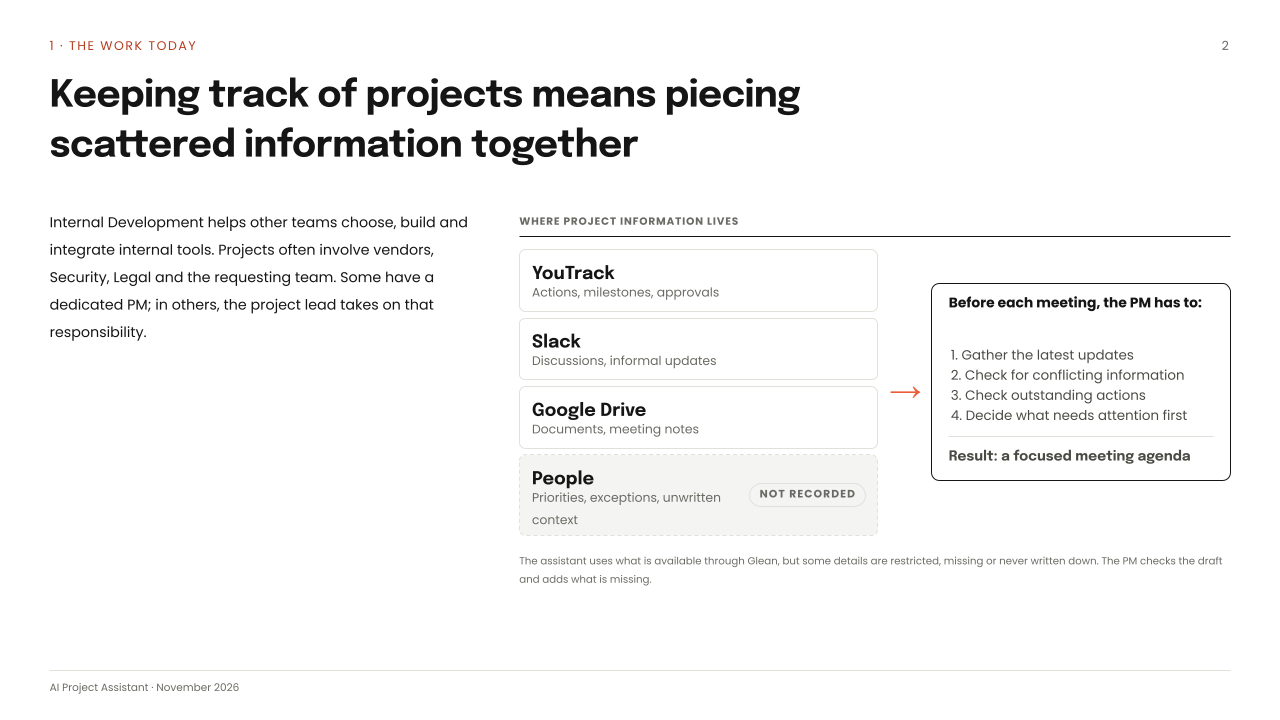
The problem was familiar. Project updates sit in YouTrack, Slack, Google Drive and people's heads. Before every meeting, someone has to piece it all together: what changed, what's still open, who needs to act. And when that doesn't happen, the meeting itself turns into catching up instead of deciding.
I've been that person. Running six projects at once, rebuilding the picture before each meeting, and still missing something.
From 13 ideas to one pilotFrom 13 ideas to one first step
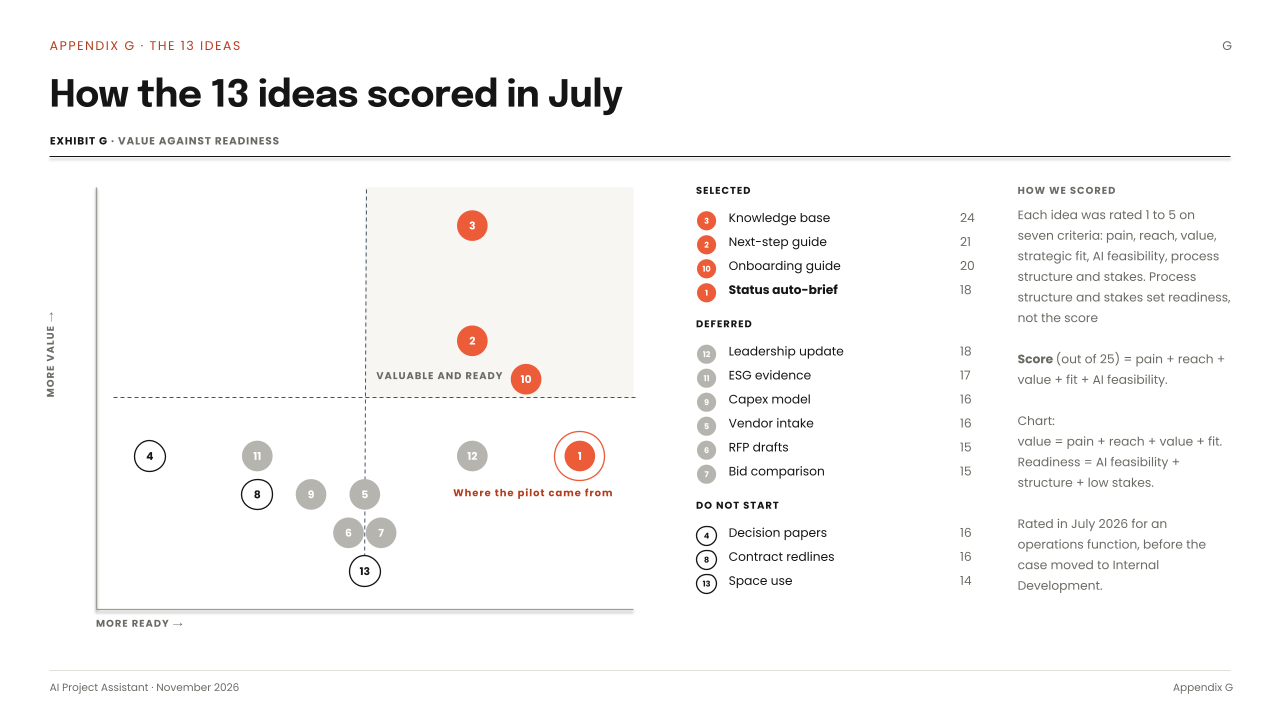
I started with 13 ideas for where AI could help and scored them. The top one, a knowledge assistant, already existed in a way: Glean already helps people find information across JetBrains' tools. The opportunity I wanted to explore was bringing that information together around a live project, so the team could see what needed attention before a meeting.
So I set out to design an AI agent that could work almost like an independent project manager. Track progress, spot issues, follow up on actions.
Then I talked it through with Dima and saw how much it would take. Clean data first. Clear permissions. Someone to watch what it does. And a lot of the context still lives in people's heads, not in any system.
I scaled it back. A lot.
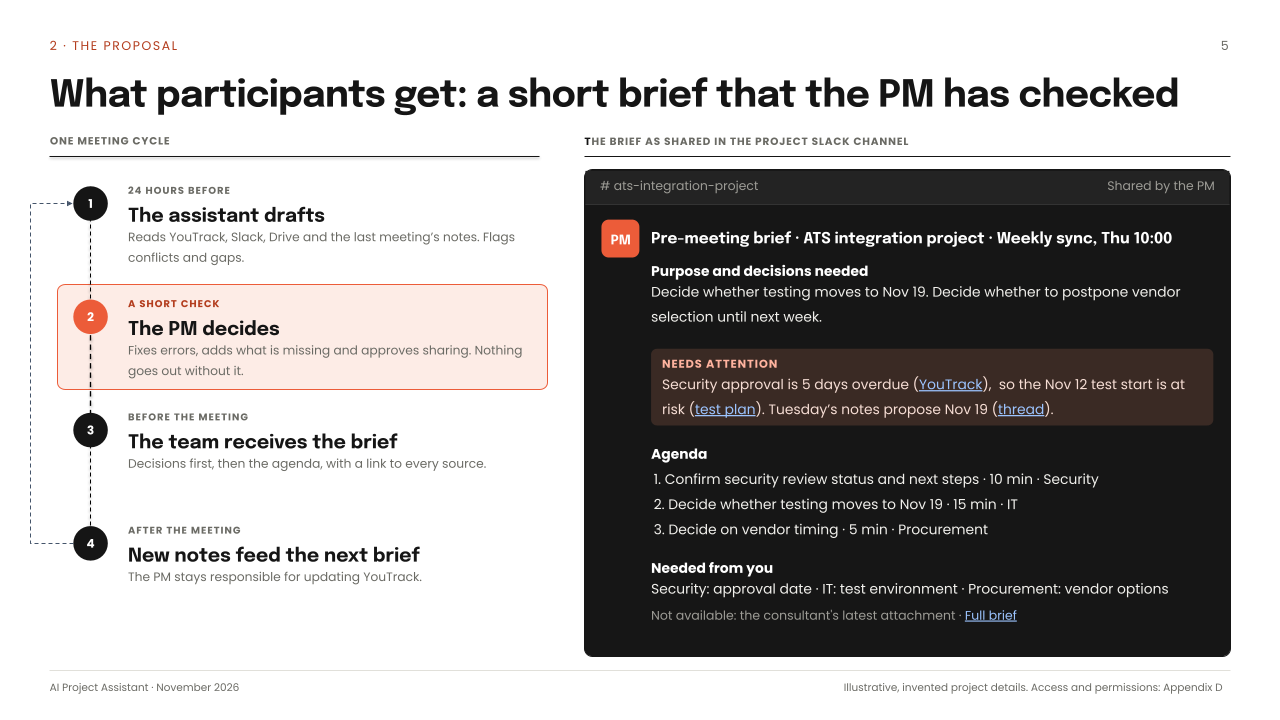
From 13 ideas to one pilotThe proposal starts with a pre-meeting brief. Before each meeting, the assistant would draft a short brief from the project information it can access and flag possible conflicts or gaps. The PM would check the sources, fix what's wrong, add what's missing and decide what to share.
What participants getNot quite the shiny agent I had in mind. :)
And yes, Copilot and Gemini already help people prep for meetings. The idea here wasn't just to help one person prepare. It was to give the whole project team a shared, checked picture of what needs discussing and deciding.
It's also a test. If the AI can't get the brief right, it's too early to let it update records or message people. If it can, the next steps, like status reports and maybe a few approved actions, have something to stand on.
What the pilot would need to prove
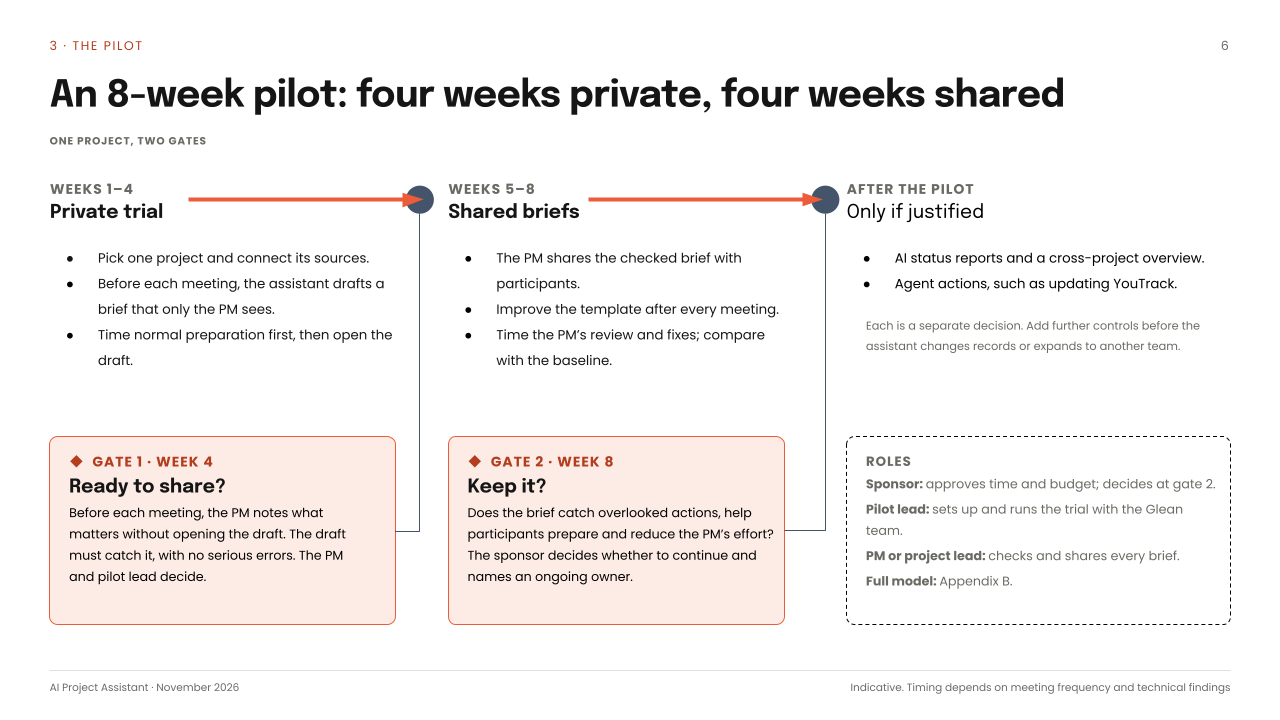
The pilot is eight weeks on one project. Four weeks private, where only the PM sees the drafts and compares them with what they'd have caught themselves. At week four, the question is simple: is it reliable enough to share? If yes, four weeks shared with the team. At week eight: does it save time once checking and corrections are counted, does it catch things people would have missed, and do participants arrive better prepared? Two checkpoints and a few clear roles. Enough structure to make a decision, not enough to slow a small trial down.
The 8-week pilotWhat I took away
What surprised me most was how little of the work was about technology. Most of it was choosing the right first step, agreeing who decides, and being honest about what we don't know yet.
So, to be clear about the outcome: this is a proposal and a pilot plan, shaped by my conversations with Dima. Not a deployed system, and no measured results yet. The pilot might show the brief isn't worth the effort, and that would be a useful answer too.
I've always believed meetings are for discussing and deciding, not for catching up. If a brief can move some of that catching up out of the meeting, people get more time for the part that matters.
It's the same on a building site. Many parties, scattered updates, one meeting where something slips. I suspect it shows up wherever people work across teams.
If your team is stuck between too many tools and too many status meetings, I'd be happy to compare notes. Helping teams turn a messy problem into a small plan they can actually test is the kind of work I do.
Read the proposal
A case study prepared for the Oxford Saïd Leading AI Implementation Programme, with input from a team lead in JetBrains' Internal Development team.
