
The Right Role. Not Just a Good One
A good role can still be the wrong one. Real career fit sits at the intersection of four things: what gives you energy, what you’ve actually proven, what the market values, and what you can sustain. The goal isn’t to find a perfect job, but to make the trade-offs visible before you choose it.

Most people approach a job search as a matching problem. You have a set of skills. There are roles in the market. The task is to find where they overlap. Apply to those. Hope one works out.
That sounds reasonable. And it mostly produces reasonable results. A job that fits on paper. A title that makes sense. Stability. Compensation. A role you can do well.
But something doesn't click. You take it, and six months in you realise the energy you expected isn't there. Or you stay in a role for years because it's comfortable and respectable, and slowly notice it's taking more out of you than it's giving back. Or you land something exciting and ambitious, and then discover you haven't built the track record to execute at the level the role actually demands.
None of these are bad decisions. They just weren't the right ones.
The difference between a good job and the right job isn't visible from the outside. It requires a different kind of map.
What the map actually needs
I've been sitting with this for a while, and what I kept coming back to is that the standard tools for thinking about career fit miss something important. Most frameworks ask: what are you good at? What do you want? Where is the market? Those are useful questions, but they're not sufficient. They don't account for what you can actually sustain over time, and they don't force an honest look at where those three things actually overlap, as opposed to where you wish they did.
So I adapted the Ikigai framework into something more practical for career decisions. Not as a philosophy. As a diagnostic. The goal was to answer a more precise question: which roles sit at the genuine intersection of all four dimensions, and which ones only look like they do?
The four dimensions are: what drives your energy, what you've proven, what the market values, and what you can sustain. The map only works when you hold all four at once.
What drives your energy
This is the dimension most people either ignore or romanticise. The question isn't what you enjoy in theory. It's what kind of work actually energises you in practice, the kind where you leave a meeting or finish a project and feel more engaged, not less.
The sub-questions that matter here are specific. What type of problems do you actually want to work on? Not just a vague category, but the texture of the problem. Some people come alive in ambiguous, open-ended strategic problems. Others thrive when the problem is defined and the work is execution at pace. What pace and intensity do you function best at? What's your preference on the autonomy-versus-structure axis? Do you do your best work when you're operating independently with a clear mandate, or when you're part of a tight team with shared accountability? And what does the environment need to feel like for you to actually function at your best?
These aren't soft questions. They're diagnostic. And ignoring them is how people end up in roles that look right but feel wrong.
What you've proven
This is harder to look at honestly, because it requires separating what you know how to do from what you've actually delivered.
The relevant evidence here is specific: what outcomes have you concretely achieved, not what you've been responsible for? Where have you had real ownership, the kind where the result was genuinely yours to win or lose? What scope and scale of work have you operated at, and is that scope expanding or staying flat? And what from your track record is actually transferable to a different context, rather than being dependent on the specific team, brand, or system you were operating inside?
This matters because the market makes decisions based on evidence, not potential. A role that's a genuine reach is worth pursuing, but you need to know where the credibility gap is before you're in the room. Otherwise the narrative breaks down at the moment it matters most.
What the market values
The third dimension pulls the other two toward reality. Energy and proof aren't enough if the market isn't looking for what you're offering.
What's actually being hired for right now, in roles at your level, in your sector? What does compensation look like for the work you're describing as your target? Which industries are creating genuine demand for the profile you're building, and which ones are hiring for a version of it that's already being commoditised? And what signals are you picking up from the companies themselves, the quality of the inbound, the seniority of the people initiating conversations, the clarity of the mandate in the job description?
The market dimension is the reality check. It doesn't tell you what you should want. But it tells you whether what you want is available, and at what cost if it's not.
What you can sustain
This is the fourth dimension, and it tends to get treated as a constraint rather than a factor. But it belongs at the centre of the analysis, not at the end as a filter.
The questions here are: what does your life actually require right now, in terms of time, location, and pace? What's your realistic energy over a multi-year horizon, not just for the first year when everything is new and motivating? And what personal constraints, family, health, geography, financial commitments, are genuinely non-negotiable versus negotiable with the right conditions?
Sustainability is what separates a role you can do for two years from a role you can build something meaningful inside.
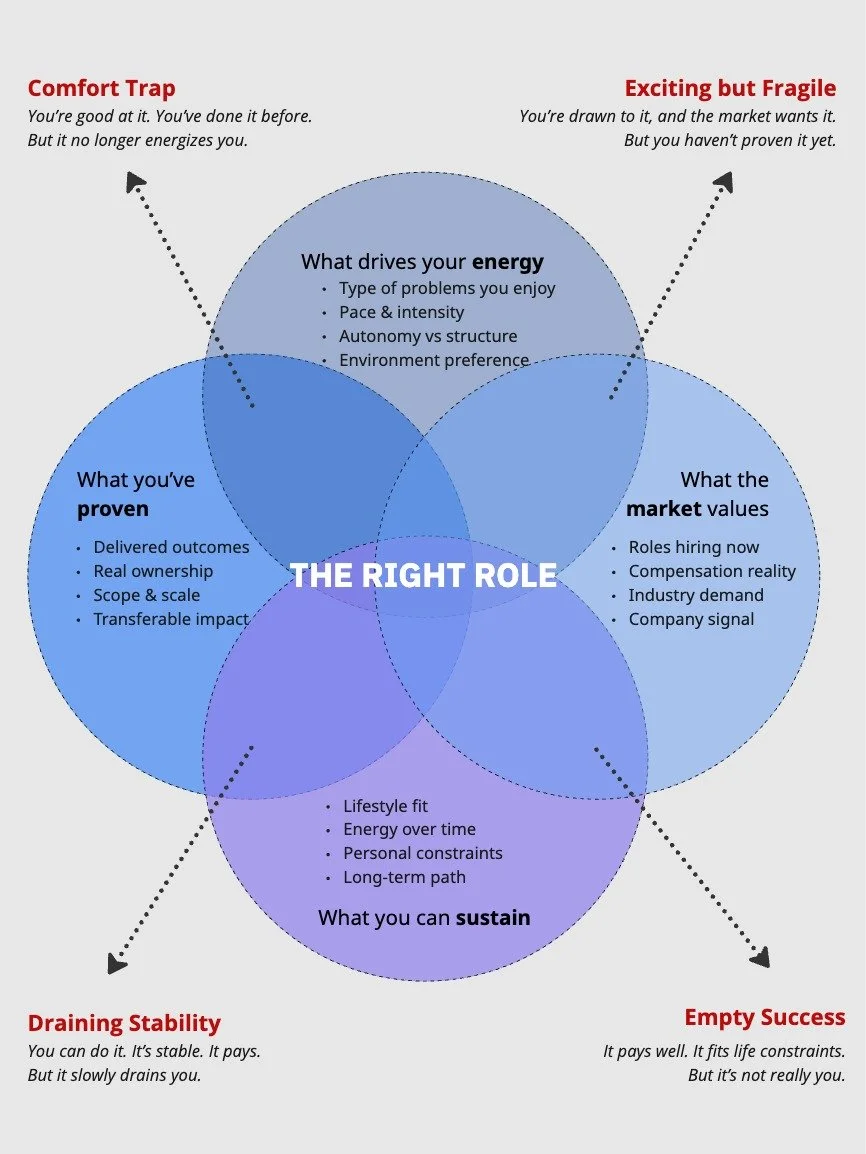
The four zones
When you map these dimensions, four zones appear. And the most important thing about them is that none of them are failures. They're just honest descriptions of where different combinations of factors actually land.
The first is the Comfort Trap. This is where your track record and your energy used to align, but no longer do. You're good at it. You've done it before. The market recognises you for it. But it no longer energises you, and the growth has quietly stopped. The danger here isn't incompetence. It's that these roles are easy to take and hard to leave. They feel safe. They look credible on paper. And they slowly become a ceiling without ever announcing themselves as one.
The second is Exciting but Fragile. Here your energy and the market are aligned, which makes these roles feel like the obvious right move. You're drawn to the work, and there's genuine demand for it. But the credibility gap is real. You haven't proven enough in this territory yet, which means the narrative is harder to hold together, and the risk of underdelivering is higher than it appears from the outside. These aren't roles to avoid. They're roles that need a plan, a way of closing the proof gap before or during the role, rather than hoping no one notices.
The third is Draining Stability. These roles check the right boxes on paper. You can do the work. The compensation is fair. The structure is clear. But something about the combination of the problem type, the pace, the environment, or the mandate slowly drains the energy over time. The risk here is that you stay longer than you should, because leaving feels irrational when everything looks reasonable from the outside. The cost shows up not in the first year but in the third.
The fourth is Empty Success. This is the most uncomfortable zone to name. These roles pay well. They fit your life constraints. They're defensible. But they're not really you. The work doesn't use what you actually care about, and the trajectory they put you on doesn't lead where you actually want to go. The trap is that the external validation makes it hard to justify the discomfort. The gap is internal, and internal gaps don't show up in LinkedIn profiles or performance reviews.
What makes the map useful
The map doesn't tell you what to do. That's not the point of it. What it does is give you an honest picture of where you actually sit before you make the decision, rather than after.
Most people build their narrative from two dimensions: what they've proven and what the market values. Those two are the most visible and the easiest to articulate. But when energy and sustainability aren't in the picture, the fit is incomplete. You can construct a compelling case for a role and still be wrong about whether it's the right one.
The map forces the less comfortable questions first: what actually energises me, not what I think should energise me. What can I genuinely sustain, not what I'm willing to manage for a year or two. And where do those honest answers actually sit relative to my track record and the market?
That's a harder conversation to have with yourself. But it produces a more honest answer. And honest answers, applied early, save a lot of misaligned effort later.
The goal isn't a perfect role. It's a role where the trade-offs are visible before you make them, and the ones you're making are ones you'd actually choose.
